| MJO Index from Climate Prediction Center | ||||
|
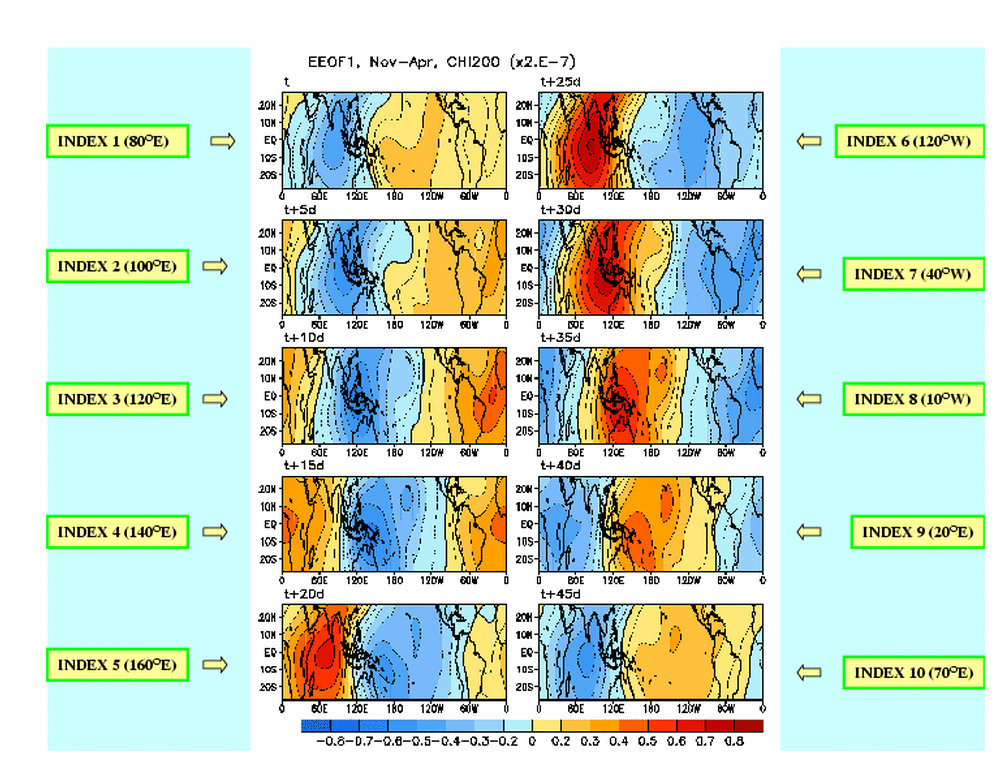
Introduction Being interested in interaction between tropical convection and the MJO, the idea is to look at the evolution of weather states as a function of the MJO phase. For this purpose, an MJO index is used in this study to estimate the date (in pentads) that the peak of an MJO event passes different longitudes. Several MJO indices have been used in the past to define an MJO cycle. The basic principle is to analyse empirical orthogonal function (EOF) or extended EOF of different fields. Index can differ from fields and data used, bandpass-filter or could be averaged over different latitude bands as well. There is no consensus, which is understandable since there is no clear picture as MJO formation and development. For instance, Maloney et al. (1998) used an index based on the first two EOFs of the bandpass-filtered (20-80 days) 850hPa zonal wind averaged from 5N to 5S every 2.5 around the equator. Using the same resolution around the equator but averaged from 15N to 15S, Wheeler et al. (2004) got an index based on the first two EOFs of the combined fields of 850hPa and 200hPa zonal winds obtained via the NCEP/NCAR reanalysis, and OLR data measured by the NOAA polar-orbiting satellites. Extending the latitude band to 30N to 30S every 1 around the equator, Tian et al. (2006) in a recent study selected MJO events via an index based on the first extended EOF analysis of the bandpass-filtered (30-90 days) rainfall anomalies. Finally, Chen et al. (2008) used an index based on the first extended EOF analysis of 200hPa velocity potential anomalies from equatorward of 30N. Among these indices, we decide to use the last one since this MJO index is only dependent on the large-scale circulation.
Data and Analysis Method
This MJO index is available online from the National Oceanic and Atmospheric Administrations Climate Prediction Center. To download this MJO index, click HERE.
The MJO cycle being triggered over the Indian Ocean and/or the breakdown of the MJO activity happening over the Mid-Pacific Ocean (i.e., Wheeler et al. 2004), we then focus our study over this Indo-Pacific warm pool (60E to 180E).
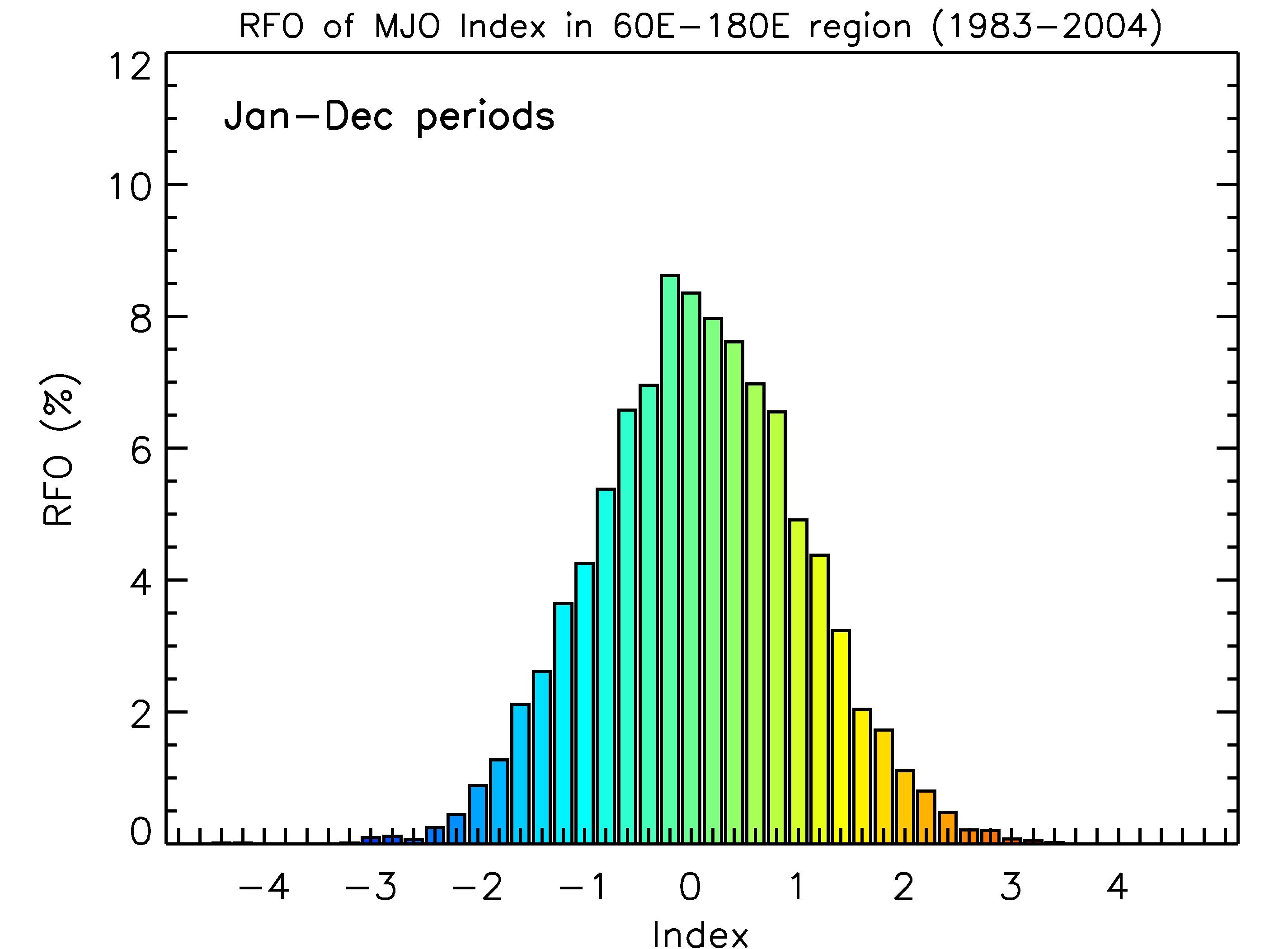
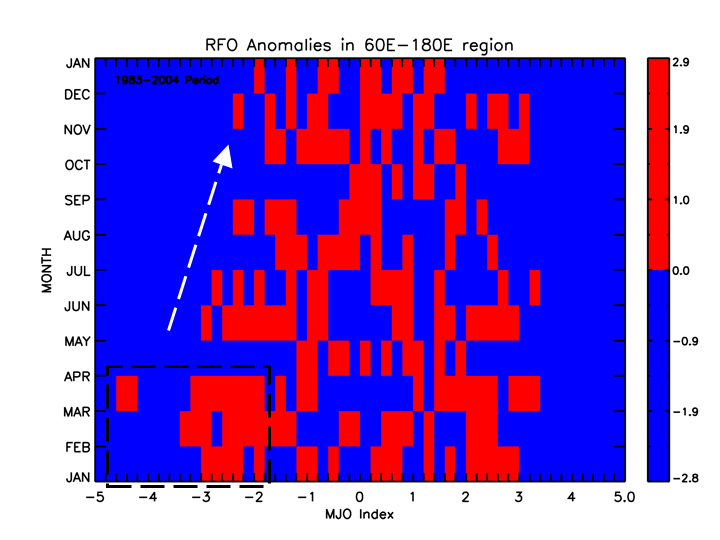
The figure above on the left shows the annual mean histogram of relative frequency of occurrence (RFO) of the MJO index averaged over 1983-2004 periods. It is interesting to note that this quasi-symmetric histogram shows us clearly a continum of index values. The choice of an index threshold to define a strong MJO event then becomes arbitrary! If we consider having a strong MJO when MJO index is inferior to -1, MJO activity would be then always strong during the year, which is not. So, it is clear now that we have to define a new threshold in order to point out an MJO event as strong. Besides that, index -1 is not an exceptional value where RFO is around 6%. This means that an MJO signal is present all over the year. To download the analysis software (IDL) plotting the annual mean histogram, click HERE. Going further in this analysis, we can substract this annual mean histogram to each monthly mean histogram. We then obtain the RFO anomalies of MJO index over the year as presented on the figure on the right. Positive anomalies are in red. There are more extreme index values (below -2) where anomalies are positives during the boreal winter (black dash square). This could be the signature of a strong MJO. Besides, positive anomalie distribution becomes narrower when we look at values going from April to November (white dash arrow). These values could then be the signature of the decreasing MJO activity during the boreal summer. This activity is always active during the year but just weaker during this period. Whatever the period and the MJO index threshold, we continuously have MJO events over the year. To download the analysis software (IDL) plotting the RFO anomalies of MJO index, click HERE.
References
|